Boynton Beach TV Mounting: Code Violations & Safety Guide
Mounting a TV in Boynton Beach involves more than finding a stud. Learn how Florida Building Code, CBS walls, and in-wall power cables impact DIY vs pro decisions.
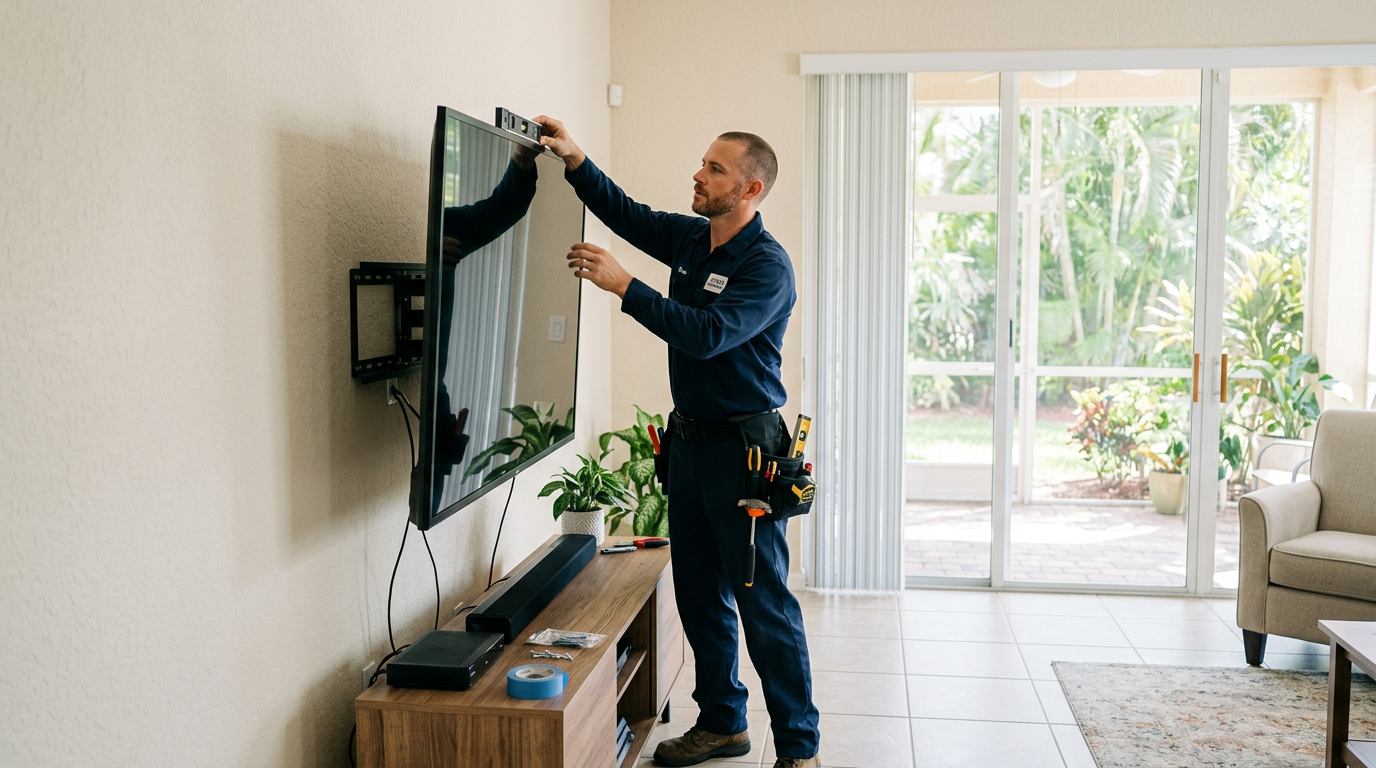
In Boynton Beach, professional TV mounting costs between $125 and $350 for standard interior drywall installations, while mounting on concrete block (CBS) exterior walls or running in-wall power extensions ranges from $220 to $500+. Standard labor takes between 1 and 3 hours, depending on whether your home utilizes traditional wood framing, light-gauge metal studs, or concrete masonry units (CMU). Costs vary based on television screen size, bracket style, wall substrate, and cable management needs.
Mounting a flat-screen television seems like a straightforward weekend DIY project. However, in Palm Beach County, unique local building construction standards, home association covenants, and strict electrical fire codes quickly elevate a basic mounting job into a complex safety issue. What begins as a quick drill job can lead to damaged electrical lines, cracked exterior masonry, or severe code violations if handled improperly.
Concrete Block (CBS) Walls vs. Interior Drywall in Boynton Beach
Residential construction in Boynton Beach differs significantly from northern states and interior U.S. markets. Single-family homes in communities like Canyon Isles, Valencia Reserve, Aberdeen Golf & Country Club, and Boynton Waters rely heavily on Concrete Block Structure (CBS) construction for wind resistance and thermal insulation.
Understanding your wall anatomy is essential before picking up a power drill:
- Exterior CBS Walls: On exterior walls, drywall is rarely fastened to standard 2x4 wood studs. Instead, 1/2-inch or 5/8-inch drywall is fastened directly to thin 1x2 inch wooden furring strips attached to solid concrete block. Standard 2-inch lag bolts included in consumer TV mount boxes will strike hard concrete less than an inch into drilling, snapping standard hardware or cracking the block face.
- Interior Wood Stud Framing: Interior partition walls separating bedrooms or living areas typically use standard 16-inch center wood studs. Finding the center of the stud using a calibrated electronic stud finder is critical to supporting heavy dynamic loads.
- Metal Stud Construction: High-rise condominiums and multi-family developments along Federal Highway and near Quantum Town Center frequently utilize interior metal stud framing. Metal studs cannot support standard lag bolts; using traditional screws in light-gauge steel causes hardware to pull straight out under load.
When securing heavy displays to CBS block walls, installers must use specialized masonry bits and heavy-duty sleeve anchors or corrosion-resistant Tapcon fasteners. Over-tightening fasteners into concrete block can strip the masonry material entirely, destroying the wall's holding power.
Florida Building Code & Electrical Safety: The In-Wall Cable Trap
One of the most common DIY mistakes in Boynton Beach is attempting to hide the black factory TV power cord inside the wall cavity by cutting two holes in the drywall and fishing the wire through.
This practice directly violates National Electrical Code (NEC) Article 400.12 and the Florida Building Code (Residential), which strictly prohibit running flexible cords and cables through holes in walls, ceilings, or floors. Standard appliance power cords are not fire-rated (plenum- or riser-rated) for concealed spaces. If an electrical arc or overheat occurs inside the closed wall cavity, a non-rated cord can melt, ignite paper-backed drywall insulation, and start a fast-moving structure fire.
Key takeaway: Flexible TV power cords fed directly through drywall cavities violate National Electrical Code Article 400.12 and Florida Building Code. To legally hide wires inside a wall, you must install an ETL/UL-listed in-wall power extension module or a recessed electrical outlet hooked to standard NM-B (Romex) wiring.
Low-Voltage vs. High-Voltage In-Wall Rules
To pass home inspections and maintain insurance coverage, cable management must follow clear technical separations:
- High-Voltage Power: Must utilize either a hardwired electrical outlet installed behind the mount or an ETL/UL-listed bridge kit featuring code-compliant building wire.
- Low-Voltage Signal Lines: HDMI cables, optical audio cords, and ethernet cables running inside wall cavities must carry an explicit CL2 or CL3 rating for flame-retardant safety.
- Vapor Barrier Protection: On exterior CBS walls, piercing the interior insulation barrier creates thermal leaks, allowing hot, humid South Florida air to enter wall cavities, creating ideal conditions for hidden mold growth.
If hiding cables requires cutting drywall access panels, combining your project with professional drywall repair ensures the wall retains its smooth finish, structural integrity, and fire rating.
HOA Regulations and Shared Wall Structural Rules
Boynton Beach features hundreds of active Homeowners Associations (HOA) and condominium boards, from active-adult neighborhoods along Woolbright Road to modern urban townhomes near Renaissance Commons. Associations enforce specific regulations that directly impact mounting choices:
Shared Firewalls and Sound Attenuation
In townhomes and condo developments, shared party walls separating adjacent units are engineered fire barrier assemblies (often multi-layered Type X fire-code drywall or solid cinder block). Cutting unapproved opening boxes or drilling deep penetrating anchors into common party walls breaks fire separation compliance and transfers structural vibration.
Cantilever Leverage and Articulating Mount Safety
Full-motion or articulating mounts allow you to pull a large television out from the wall and swivel it toward the kitchen or patio. However, when an 85-inch, 75-pound television is extended 22 inches away from the wall, cantilever leverage multiplies the pull-out force exerted on top anchors by up to 400%.
If installed into drywall alone using hollow-wall toggle bolts or set into thin metal studs without structural backing plates, cantilever forces can pull the upper fasteners directly out of the wall structure, damaging your television and threatening room safety.
Key takeaway: Articulating mounts exert intense rotational torque on wall fasteners. Mounting heavy televisions onto metal studs or CBS furring strips requires structural anchor distribution to prevent catastrophic wall failure and structural collapse.
If you are upgrading accent walls, installing custom TV accent paneling, or mounting above fireplaces lined with stone or porcelain, careful preparation prevents expensive material damage. Miscalculated drilling through wall tile requires complete tile repair or costly panel replacements.
2026 Boynton Beach TV Mounting & Code Compliance Cost Guide
The table below outlines realistic 2026 price ranges for professional TV mounting services in Boynton Beach based on structural conditions, wall substrates, and code requirements:
| Installation Scenario | Pro Cost Range (Boynton Beach) | DIY Risk & Complexity | Key Technical & Code Requirements |
|---|---|---|---|
| Standard Drywall Mount (32"–65") | $125 – $190 | Low | Locating central wood studs, level mounting, surface-mounted cable raceways |
| Exterior CBS / Concrete Block Mount | $180 – $275 | Moderate to High | Masonry drilling, Tapcon/Sleeve anchors into CMU, depth clearance check |
| Metal Stud Installation (Condos) | $160 – $240 | Moderate | Heavy-duty Snaptoggle fasteners, load distribution across steel framing |
| In-Wall Power Bridge Kit Addition | $150 – $250 | High (Electrical Code) | UL-listed in-wall bridge, CL2/CL3 rated low-voltage signal cables (NEC 400.12) |
| Fireplace / Custom Tile Wall Mounting | $220 – $380 | High | Diamond core drilling, thermal distance check, crack-prevention anchoring |
| Large TV Articulating Mount (75"+) | $200 – $325 | High | Multi-stud span alignment, heavy torque calculation, strain relief safety |
The Line Between Weekend DIY and Pro Jobs
Knowing when to tackle a TV mounting job yourself and when to call a licensed professional handyman protects both your equipment and your home's equity.
Safe DIY Conditions
- Small to medium televisions (under 55 inches) using fixed or basic tilt mounts.
- Interior partition walls with clearly identifiable 16-inch center wood studs.
- Surface-mounted plastic cord covers (raceways) used to hide cables cleanly along the wall exterior.
Professional Handyman Requirements
- Mounting on exterior concrete block (CBS) or stucco-finished interior walls.
- Installations in condominium buildings with light-gauge metal stud framing.
- In-wall cable routing that requires code-compliant power extension installations.
- High-value installations over decorative tile, stone fireplaces, or custom accent walls.
- Pairing TV mounting with broader room updates like light fixture installation or routine property maintenance.
When structural anchors are installed incorrectly, patching damaged drywall and matching local wall textures (such as knock-down, orange peel, or popcorn) requires skilled repair work. Partnering with experienced local technicians ensures your mounting project is completed cleanly, safely, and fully up to code.
Get a free estimate
Ensure your TV mounting project is safe, secure, and fully compliant with Florida Building Code. Call Palm Handyman today at (561) 299-0890 or book your appointment online at /book for expert service in Boynton Beach.
Need a handyman in Palm Beach County?
Get a free written estimate in minutes. Same-day appointments available across PBC.
Related services
Frequently asked questions
Most jobs start at $95 for the first hour with transparent flat-rate pricing on common tasks like TV mounting ($129), ceiling fans ($149), and drywall patches ($95). You'll always get a clear quote before any work begins — no hidden fees.
Yes. We reserve same-day and next-day appointments across Boca Raton, Delray Beach, Boynton Beach, West Palm Beach, Palm Beach Gardens, Jupiter, Lake Worth, and Wellington. Call us before noon for same-day availability.
Absolutely. Palm Handyman is fully licensed in Florida and carries $2M general liability plus workers' comp on every technician. We'll send the COI directly to your HOA or property manager on request.
We cover all of Palm Beach County including Boca Raton, Delray Beach, Boynton Beach, West Palm Beach, Palm Beach Gardens, Jupiter, Lake Worth, Wellington, Palm Beach Island, Manalapan, and Highland Beach.