Delray Beach TV Mounting: DIY Safety, Building Code & Costs
Mounting a TV in Delray Beach involves concrete block walls, metal studs, and strict electrical codes. Learn when DIY crosses the line into safety and code violations.
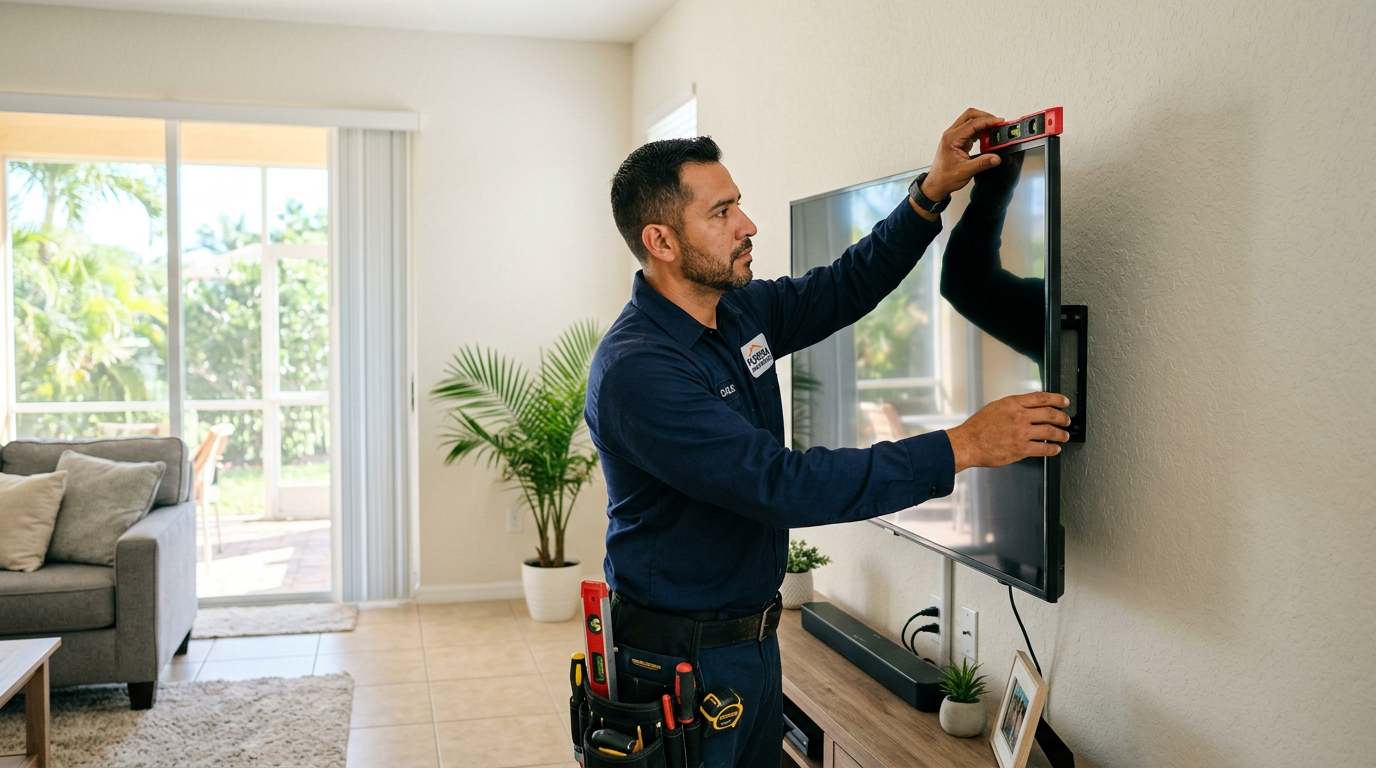
Professional TV mounting in Delray Beach, FL ranges from $125 to $450, depending on television size, wall construction (drywall over wood studs, hollow concrete block, or metal studs), and concealed electrical wiring requirements. Mounting a television shifts from a simple weekend project to a code and safety issue the moment standard flexible power cords are concealed inside a drywall cavity—violating National Electrical Code (NEC) Section 400.12—or when heavy loads are mounted to non-structural materials without proper anchoring hardware.
While hanging a light 32-inch screen on a wood-framed interior wall is manageable for many homeowners, South Florida’s architectural realities often complicate things. Between coastal masonry construction, strict HOA architectural controls, and strict electrical guidelines, executing a seamless TV mounting installation requires understanding both structural mechanics and local building codes.
Delray Beach TV Mounting & Wall Prep Cost Guide (2026)
The cost of TV mounting in Delray Beach depends heavily on wall substrate, screen size, and power management choices. Below are baseline pricing estimates for typical residential installations:
| Installation Type | Average Cost Range | Typical Requirements & Details |
|---|---|---|
| Standard Drywall Mounting (32"–65") | $125 – $195 | Wood stud attachment, external cable raceway, standard fixed or tilt bracket. |
| Large Screen Drywall Mounting (70"–98") | $195 – $295 | Heavy-duty dual-arm full motion mount, reinforced stud anchoring. |
| Masonry / Concrete Block (CMU) Wall | $175 – $325 | Masonry drilling, Tapcon/expansion anchors, common in Lake Ida & Tropic Isle homes. |
| Metal Stud Mounting (Condos & High-Rises) | $175 – $300 | Heavy-duty toggle bolts (SnapToggle), common in Pineapple Grove & Downtown Delray. |
| Code-Compliant In-Wall Power Extension Kit | $150 – $250 | UL-listed in-wall rated power module installation (excludes main panel work). |
| Drywall Repair & Texture Patching | $150 – $350 | Patching damage from failed DIY mounts using professional drywall repair. |
Structural Realities of Delray Beach Homes
Hanging a 75-inch television is not just about holding weight; it is about resisting leverage. When extended on a full-motion articulated arm, a 65-pound TV can exert over 200 pounds of pulling force on top fasteners. In Delray Beach, wall construction varies dramatically depending on the neighborhood and era of construction.
Concrete Block Construction (CMU)
In established single-family neighborhoods like Lake Ida, Tropic Isle, and Rainberry Bay, exterior walls and many interior partition walls consist of furred-out Concrete Masonry Units (CMU).
- The DIY Trap: Standard drywall anchors or basic plastic expansion plugs will fail almost immediately when driven into 3/4-inch furring strips or hollow cinder block.
- The Professional Approach: Mounting requires carbide-tipped masonry drilling into the solid shell of the block or heavy-duty structural masonry anchors (such as 1/4-inch Tapcons or sleeve anchors) set to specific torque specifications.
Metal Stud Framing in Downtown Condos
High-rise and mid-rise residential developments throughout Downtown Delray Beach and Pineapple Grove rely heavily on light-gauge steel stud framing behind drywall for interior partition walls.
- The DIY Trap: Driving standard wood screws or self-tapping sheet metal screws into 25-gauge metal studs offers almost zero pull-out strength. Over time, dynamic movement from adjusting the TV bracket will enlarge the hole and cause the wall mount to pull free.
- The Professional Approach: Steel studs require specialized heavy-duty hollow-wall toggle anchors (such as SnapToggles) that span the steel flange, distributing the load across the structural steel member without crushing the thin metal profile.
Key takeaway: Never rely on plastic drywall anchors or standard wood screws when mounting heavy displays to metal studs or concrete block walls. Mechanical failure often results in severe wall damage and ruined electronics.
The Hidden Hazard: Electrical Code Violations
The most common error made during DIY TV installations involves cord management. Homeowners naturally want to conceal ugly black power cords and HDMI cables behind the wall. However, running a standard TV power cord inside a wall cavity is a direct violation of National Electrical Code (NEC) Article 400.12 (which explicitly prohibits using flexible cords as a substitute for fixed structure wiring).
Why Concealing Standard Cords Is Dangerous
Flexible appliance cords are not rated for in-wall temperatures or fire resistance. Inside a wall cavity:
- Heat Dissipation: Cords trapped in insulated wall cavities can overheat.
- Puncture Hazards: Unprotected flexible cords are susceptible to damage from drywall screws, picture nails, or pest activity.
- Fire Hazard: In the event of an electrical short, standard zip cords can burn rapidly and spread fire within the wall cavity before breaker tripping occurs.
The Code-Compliant Solution
To legally conceal wiring inside a Delray Beach home, you have two options:
- UL-Listed In-Wall Power Extension Kit: These kits feature high-voltage Romex-rated wiring that runs safely inside the wall between an upper outlet module behind the TV and a lower inlet module near an existing baseboard outlet.
- Dedicated Receptacle Installation: Hiring an electrician or qualified specialist to hardwire a new junction box behind the TV position, connected to your main panel or existing circuit, alongside proper low-voltage pass-through plates for HDMI and optical cables.
If you are upgrading your entertainment area lighting at the same time, combining TV prep with light fixture installation or ceiling accent lighting keeps your living space visually clean while meeting local electrical standards.
HOA Rules, Condo Boards, and Wall Boundaries
Living in a Delray Beach HOA community—whether it is a active adult enclave like Kings Point or an exclusive country club community like Mizner Country Club—introduces an additional layer of oversight.
Common Wall Restrictions in Multi-Family Units
In condominiums and attached townhomes, interior walls dividing units are often fire-rated demising walls or party walls.
- Fire Wall Integrity: Penetrating a two-hour fire-rated drywall partition with deep cutouts for junction boxes or unsealed cable pass-throughs violates building code and condo association rules. Intumescent fire-stop sealants or fire-rated putty pads are required around any penetrations.
- Sound Transmission Class (STC) Ratings: In multi-family buildings, anchor drilling into shared structural walls can transfer low-frequency sound and vibration to neighboring units. Using isolation dampeners and avoiding deep structural penetrations protects shared wall acoustic ratings.
- Architectural Review Board (ARB) Guidelines: Exterior patio TV installations often require prior ARB approval to ensure visible wiring does not violate community standards.
Key takeaway: Check your condo declaration documents before drilling into shared unit walls or exterior stucco patios. Unapproved penetrations through fire barriers can lead to costly fines and mandatory remediation.
Outdoor TV Mounting on Florida Patios
Outdoor living is a hallmark of Delray Beach homes, but mounting a TV on a covered lanai or outdoor patio presents severe environmental challenges:
- Salt Air Corrosion: Living within close proximity to the Atlantic Ocean means airborne salt accelerates rust on standard steel brackets. Exterior installations require marine-grade stainless steel hardware and powder-coated outdoor-rated mounts.
- Stucco and Moisture Barriers: Exterior walls feature stucco layered over weather-resistive barriers (WRB). Improperly sealed wall penetrations allow moisture to migrate behind the stucco, leading to rot, efflorescence, and mold growth. Every exterior fastener penetration must be sealed with exterior-grade silicone or polyurethane sealant.
Maintaining outdoor entertainment areas forms a key part of long-term home property maintenance in humid coastal environments.
DIY vs. Professional Checklist: Where Do You Draw the Line?
Before picking up a drill, use this practical framework to determine whether your installation is a weekend DIY job or requires professional expertise:
Safe for DIY:
- TV size is under 50 inches and total weight is under 30 lbs.
- Mounting to standard 16-inch center wood stud interior partition walls.
- Cables are managed externally using surface-mounted cord raceways.
- No masonry, metal studs, or fire-rated demising walls involved.
Call a Professional Handyman:
- TV size is 65 inches or larger, or using a long-reach full-motion articulating mount.
- Wall surface consists of plaster, stucco, concrete block (CMU), or metal stud framing.
- You want hidden wiring with code-compliant in-wall power modules.
- Mounting above a fireplace mantel or onto decorative accent walls (shiplap, tile, or stone).
- Previous failed mounting attempts created large drywall tears requiring structural patching.
When a DIY attempt goes wrong, attempting to patch large toggle-bolt blowouts in textured drywall requires professional intervention to restore seamless wall texture. Proper patching techniques can be found through dedicated home care resources like Palm Handyman.
Get a Free Estimate
Avoid code violations, wall damage, and unsafe mounting installations. Whether you need a heavy-duty display mounted in your living room, clean cable concealment, or complete home fixture prep, Palm Handyman delivers reliable, code-compliant service across Delray Beach.
Call (561) 299-0890 today or submit your request online at /book to receive a clear, free project estimate.
Need a handyman in Palm Beach County?
Get a free written estimate in minutes. Same-day appointments available across PBC.
Related services
Frequently asked questions
Most jobs start at $95 for the first hour with transparent flat-rate pricing on common tasks like TV mounting ($129), ceiling fans ($149), and drywall patches ($95). You'll always get a clear quote before any work begins — no hidden fees.
Yes. We reserve same-day and next-day appointments across Boca Raton, Delray Beach, Boynton Beach, West Palm Beach, Palm Beach Gardens, Jupiter, Lake Worth, and Wellington. Call us before noon for same-day availability.
Absolutely. Palm Handyman is fully licensed in Florida and carries $2M general liability plus workers' comp on every technician. We'll send the COI directly to your HOA or property manager on request.
We cover all of Palm Beach County including Boca Raton, Delray Beach, Boynton Beach, West Palm Beach, Palm Beach Gardens, Jupiter, Lake Worth, Wellington, Palm Beach Island, Manalapan, and Highland Beach.