DIY vs. Pro Drywall Repair in Wellington: Code, Cost & HOA Rules
Deciding whether to patch drywall yourself or hire a pro in Wellington? Learn Florida code requirements, local repair costs, and knockdown texture secrets.
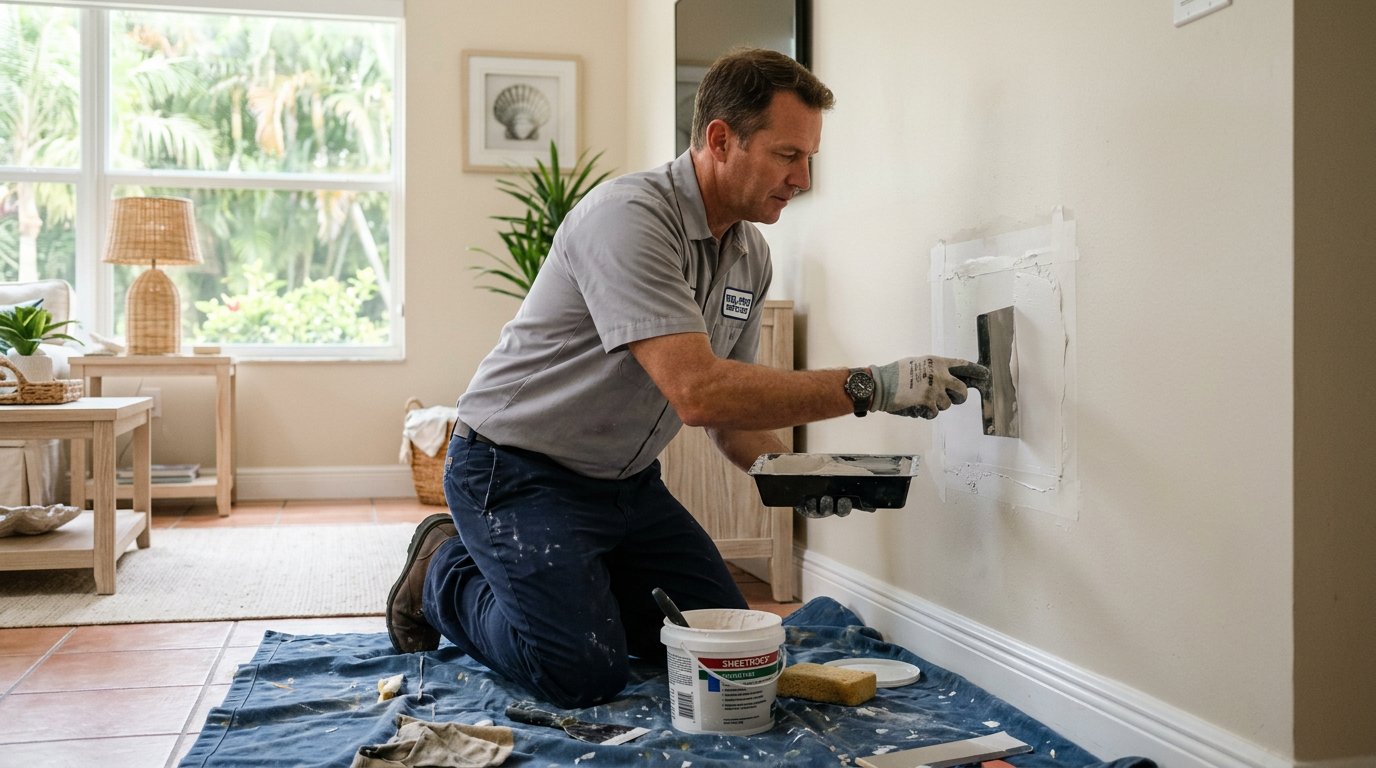
In Wellington, Florida, professional drywall repair costs between $175 and $350 for small door handle holes or minor gouges, while larger ceiling patches or water-damaged section replacements range from $450 to $950+ including seamless knockdown texture matching and priming. While simple nail hole patching is a manageable weekend DIY project, larger repairs in local communities like Olympia or Village Walk often require professional intervention to comply with Florida Building Code fire-rating requirements, proper joint compounding, and HOA waste disposal regulations. Understanding where the line falls between a quick DIY fix and a job for a licensed technician saves home equity, time, and expensive re-work.
The Honest Line: What You Can DIY vs. When to Call a Pro
Every homeowner in Wellington faces the temptation to grab a tub of pre-mixed spackle and a putty knife when a wall gets damaged. However, drywall restoration exists on a spectrum of difficulty. Assessing the scope before making a trip to the local hardware store prevents half-finished projects and uneven walls.
Minor Cosmetic Repairs (Ideal for DIY)
- Small nail and picture hanger holes: Scrapes and pinholes from hanging artwork can be filled with lightweight spackling compound, lightly sanded with a fine-grit sanding block, and touched up with leftover wall paint.
- Minor scuffs and shallow denting: Small depressions that haven't breached the paper backing of the sheetrock only require a thin skim coat and minor sanding.
- Small stress cracks in corners: Hairline cracks around window frames or interior doors caused by minor thermal expansion can often be taped with mesh tape and skimmed by an attentive DIYer.
- Simple doorknob dents: Minor doorknob impressions that haven't crushed the inner gypsum core can usually be patched with a self-adhesive mesh patch kit.
Moderate to Complex Repairs (Best Left to Professionals)
- Large holes (> 4 inches): Patching large impact holes requires backing lumber, precise sheetrock cutting, paper joint taping, feathering multiple coats of joint compound, and custom texture blending.
- Water-damaged ceilings: Leaks from top-floor plumbing or air conditioner condensate lines require identifying structural dampness, cutting back damaged drywall to healthy studs, installing new backing, and matching ceiling texture overhead.
- Garages and firewall assemblies: Repairs on walls shared between an attached garage and the living quarters must maintain fire-resistance ratings under local codes.
- Popped drywall screws and widespread tape peeling: Tape failure across ceiling joints often points to underlying structural movement or humidity intrusion that requires professional structural fastening and re-taping.
Key takeaway: If a repair involves water damage, ceiling height work, holes larger than a baseball, or fire-rated walls, hiring a professional ensures structural safety and an invisible finish.
Florida Building Code, Fire Walls, and Moisture Standards
South Florida construction differs significantly from homes in other regions. In Wellington neighborhoods like Grand Isles, Lakes of Wellington, and the Aero Club, homes are constructed with exterior Concrete Block Structure (CBS) walls combined with interior wood or metal stud framing. Understanding how drywall interacts with local building standards is critical for safety and structural compliance.
Fire-Rated Assemblies (Type X Drywall)
Under the Florida Building Code (FBC), the wall separating an attached garage from the residence's living space must function as an approved firewall partition. Standard 1/2-inch drywall is not permitted on these partition walls. Code requires 5/8-inch "Type X" fire-rated drywall, which contains unexpanded vermiculite and glass fibers within its gypsum core to retard flame spread for at least one hour.
If you accidentally puncture or cut into your garage wall—whether while building storage racks or repairing vehicle impact damage—replacing that section with standard 1/2-inch sheetrock violates building code. During a home inspection prior to sale, unapproved drywall patches on firewalls are routinely flagged, requiring complete teardown and re-repair.
Moisture and Mold Considerations
Wellington’s year-round ambient humidity and sudden summer storms create ideal conditions for mold growth inside wall cavities. When an HVAC condensate line backs up in an attic, water pools directly on top of the ceiling drywall.
Before undertaking any drywall patch over previous water stains:
- Moisture levels within the surrounding wood framing and remaining gypsum board must register below 12% on a calibrated moisture meter.
- In high-moisture zones like bathrooms or laundry rooms, replacement boards should be moisture-resistant greenboard or non-paper cementitious backing boards.
- Mildew-resistant stain-blocking primers must be applied before final texture and paint application.
Failing to address hidden moisture or using incorrect materials creates a breeding ground for mold behind freshly painted walls, turning a $250 repair into a multi-thousand-dollar mold remediation headache.
The Wellington HOA & Construction Trash Reality
Homeowners residing within Wellington's gated communities—such as Olympia, Village Walk, or Isles at Wellington—are subject to strict Homeowners Association (HOA) rules regarding property upkeep and waste disposal.
Exterior and Garage Visibility
While interior repairs are generally private, any work conducted inside an open garage or involving visible exterior stucco/drywall elements must comply with community aesthetic guidelines. Storing leftover construction debris, piles of broken sheetrock, or bags of joint compound in driveways or visible side yards can trigger immediate HOA violation notices and daily fines.
Waste Disposal Regulations
Wellington municipal waste services and private HOA bulk trash pickup providers enforce specific rules regarding construction debris. Broken drywall, plaster, and bucketed joint compound are considered construction and demolition (C&D) waste and are strictly prohibited from standard residential curbside pick-up containers.
DIYers who pile cut-up drywall sheets at the curb are frequently left with uncollected trash tags on their lawn. Professional repair contractors handle the containment, hauling, and proper recycling of all job-site waste in compliance with Palm Beach County Solid Waste Authority rules.
The South Florida Texture Barrier: Knockdown & Orange Peel
The single biggest challenge in South Florida drywall restoration is not patching the hole—it is matching the existing wall texture. Unlike homes in northern states that often feature smooth-plastered walls, nearly all modern residences in Palm Beach County feature either "knockdown" or "orange peel" drywall textures.
Smooth Drywall Base -> Texture Application (Spray/Hopper) -> Trowel Flattening -> Sealed Finish
Why DIY Texture Cans Fail
Hardware stores sell aerosol cans of quick-drying spray texture. While marketed as a quick solution, these cans rarely match the heavy, hand-troweled knockdown textures found in Wellington homes built during the late 1990s and 2000s.
Aerosol texture comes out at high pressure with an inconsistent droplet size. When flattened with a trowel, aerosol texture often looks like a smooth halo or a dark blob surrounding the patch, drawing more attention to the repair site than the original hole did.
How Professionals Achieve Seamless Blending
Professional handymen utilize adjustable pneumatic hoppers or specialized hand-knockdown technique to match texture density, pattern size, and thickness.
- Feathering the Joint Compound: A technician feathers the mud out 8 to 12 inches beyond the physical border of the patch to create a gradual transition.
- Consistency Matching: Joint compound is mixed to precise, pancake-batter consistency using professional mixing paddles.
- Pattern Blending: Texture is sprayed across the patch and gently overlapped onto the surrounding existing wall.
- Timing the Knockdown: The mud is allowed to set for a specific window (usually 10 to 15 minutes, depending on indoor humidity) before a flexible plexiglass or steel knockdown knife is dragged at a 45-degree angle to flatten the peaks.
Once the texture sets, the entire wall section usually requires a coat of sealer/primer followed by full wall-to-wall topcoat painting. Spot-painting textured patches almost always results in visible sheen differences ("flashing"). If your repair requires finishing, combining your drywall work with professional painting services guarantees a continuous, uniform finish.
Key takeaway: Spray-can texture rarely matches South Florida knockdown walls. Professional blending requires precise compound mixing, custom hopper spray settings, and wall-to-wall painting.
2026 Drywall Repair Cost Breakdown: DIY vs. Professional Handyman
When evaluating whether to repair drywall yourself or hire a professional, calculate the true cost of materials, specialty tools, waste removal, and your personal labor time.
| Repair Scope | DIY Material & Tool Cost | Professional Handyman Cost (2026) | Time Required (DIY vs. Pro) |
|---|---|---|---|
| Small Door Hole (1-3 inches) | $35 - $60 (patch kit, spackle, knife, sandpaper) | $175 - $275 (includes texture match) | 3 hrs (DIY) / 1.5 hrs (Pro) |
| Medium Wall Cutout (12x12 inches) | $75 - $125 (sheetrock, tape, mud, hopper/can) | $275 - $450 (includes texture & prime) | 6 hrs over 2 days / 3 hrs (Pro) |
| Large Wall Repair / Garage Firewall Patch | $120 - $200 (Type X drywall, 2x4s, joint tape, compound) | $450 - $700 (code-compliant Type X repair) | 8+ hrs over 2-3 days / 4 hrs (Pro) |
| Ceiling Water Damage Patch (2x2 ft) | $100 - $180 (drywall, screws, mud, texture, primer) | $500 - $950+ (includes structural check & match) | 10+ hrs over 3 days / 4-5 hrs (Pro) |
Note: DIY estimates assume you do not already own specialized tools such as a drywall saw, pneumatic hopper, compressor, mixing drill, or broad trowels.
While DIY costs look lower on paper for small patches, the cost rapidly increases if you need to buy specialized tools or if an improper patch must be torn out and re-done by a professional later.
Hidden Hazards Behind Wellington Drywall
Cutting into drywall without knowing what lies in the stud bay presents significant safety risks. Modern concrete block homes in Wellington feature dense electrical conduits, plumbing pipes, and low-voltage wiring running through interior stud walls.
Electrical Lines
Interior non-bearing walls in South Florida homes frequently carry electrical wiring for wall outlets, light switches, and wall-mounted televisions. Driving a drywall saw or long drywall screw directly into a stud bay can puncture live 120V lines, resulting in electrical arc flashes or structural fires. If you plan to repair drywall as part of a media wall project or after moving cables, pairing the fix with professional TV mounting ensures hidden wiring is properly routed away from sheetrock fasteners.
Plumbing Lines & Air Handler Drain Pipes
In two-story homes in neighborhoods like Aero Club or Olympia, water supply pipes and drain lines run vertically inside wall cavities. Furthermore, central air conditioning condensate lines travel inside interior walls from second-floor air handlers down to the exterior. Accidental punctures with a drywall saw can create small, hidden leaks that fester out of sight for months, rotting replacement drywall from the inside out.
Before cutting into any interior wall panel:
- Always turn off power breakers to the immediate work area.
- Use a high-quality electronic wall scanner capable of detecting both live AC wiring and unshielded copper or PEX plumbing lines.
- Set drywall saw blades to cut no deeper than 5/8-inch (the exact thickness of the drywall sheet) to avoid striking behind-the-wall utilities.
If you encounter complex home repairs beyond simple wall patches—such as repairing rotted trim, fixing loose doors, or addressing routine interior fixes—combining your tasks into a single comprehensive visit for general property maintenance saves both time and service fees.
When in doubt, hiring a licensed, insured handyman company protects your property, ensures code compliance, and preserves your home's long-term resale value.
Get a free estimate
Need professional drywall repair, seamless knockdown texture matching, or interior painting in Wellington? Contact Palm Handyman today for expert, licensed, and insured local service. Call us at (561) 299-0890 or book your appointment online at /book to get your free estimate.
Need a handyman in Palm Beach County?
Get a free written estimate in minutes. Same-day appointments available across PBC.
Related services
Frequently asked questions
Most jobs start at $95 for the first hour with transparent flat-rate pricing on common tasks like TV mounting ($129), ceiling fans ($149), and drywall patches ($95). You'll always get a clear quote before any work begins — no hidden fees.
Yes. We reserve same-day and next-day appointments across Boca Raton, Delray Beach, Boynton Beach, West Palm Beach, Palm Beach Gardens, Jupiter, Lake Worth, and Wellington. Call us before noon for same-day availability.
Absolutely. Palm Handyman is fully licensed in Florida and carries $2M general liability plus workers' comp on every technician. We'll send the COI directly to your HOA or property manager on request.
We cover all of Palm Beach County including Boca Raton, Delray Beach, Boynton Beach, West Palm Beach, Palm Beach Gardens, Jupiter, Lake Worth, Wellington, Palm Beach Island, Manalapan, and Highland Beach.