Wellington TV Mounting: Code, Safety & DIY vs Pro Guide
Mounting a TV in Wellington isn't just about hanging a frame—it involves Florida building codes, CBS walls, and electrical hazards. Here is what homeowners must know.
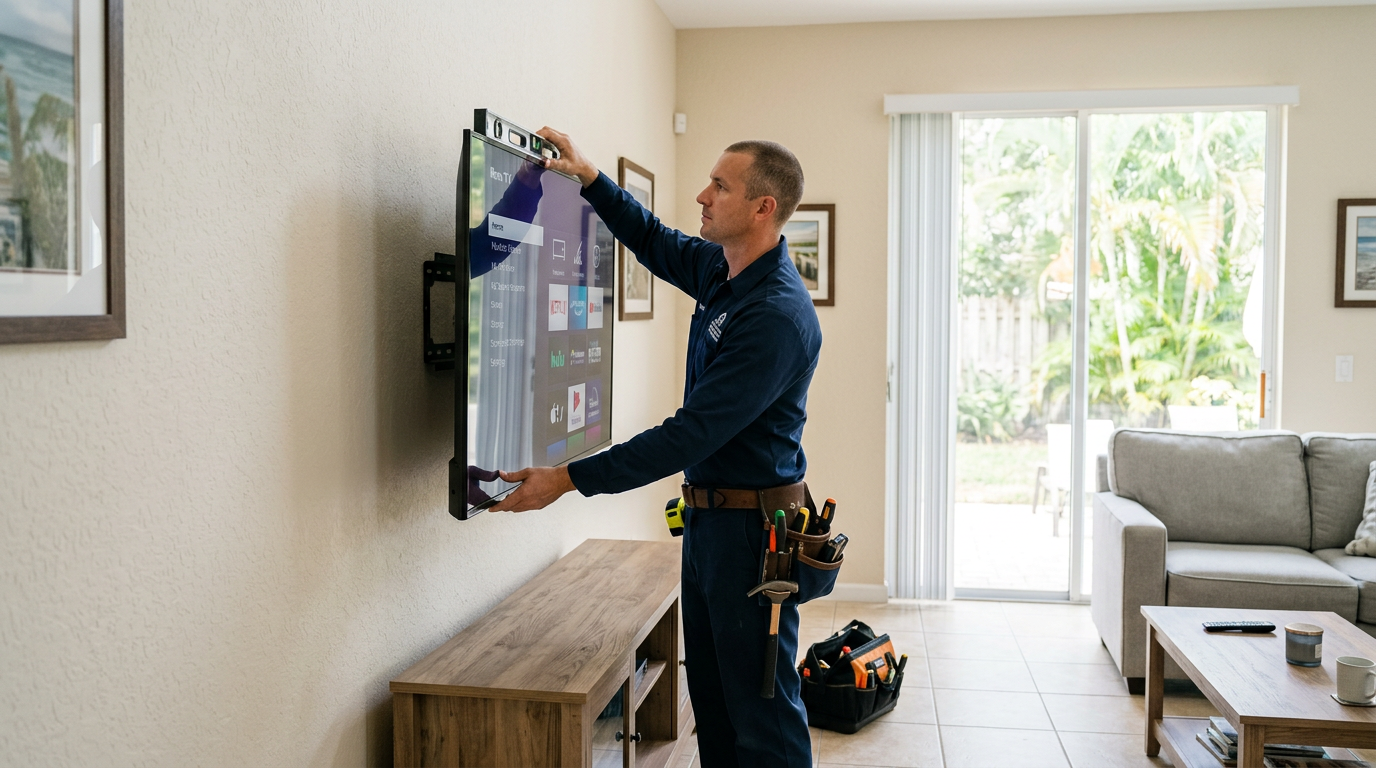
In Wellington, professional TV mounting costs between $150 and $450 depending on display size, wall composition, and cord concealment methods. Mounting a television directly onto concrete block drywall or routing flexible power cords through wall cavities violates National Electrical Code (NEC) standards and Florida Building Code. Hiring a qualified handyman ensures structural integrity on interior masonry walls, code-compliant wire management, and full compliance with local HOA guidelines.
When homeowners in communities like Olympia, Grand Isles, or the Aero Club buy a new 75-inch screen, wall mounting often seems like a quick Saturday DIY project. Armed with a basic stud finder and a battery-powered drill, many attempt to bolt the bracket above the fireplace or onto an accent wall. However, Wellington homes present distinct architectural and code challenges that make TV mounting far more complex than driving a couple of lag screws into soft wood studs.
From concrete block construction (CBS) to strict electrical fire codes, understanding where the line sits between a simple weekend task and a professional installation protects both your home's structural safety and its resale value.
The Anatomy of a Wellington Wall: CBS, Furring Strips, and Metal Studs
Most modern single-family homes in Wellington are built with concrete block construction (CBS) on the ground floor to meet rigorous Florida hurricane standards. While exterior walls are solid masonry, interior partition walls are framed with either light-gauge metal studs or traditional wood framing over furring strips.
Mounting a heavy, broad-display TV onto these varied wall assemblies requires specific fasteners and load calculation:
- CBS Exterior & Patio Walls: Interior faces of exterior masonry walls usually feature 1x2-inch furring strips attached to concrete block, covered by drywall. Standard wood screws will hit hard concrete after penetrating just three-quarters of an inch, causing the screw to strip out or snap. Securing heavy articulated mounts to these walls requires heavy-duty masonry anchors or sleeve anchors drilled directly into sound block.
- Metal Stud Framing: Many modern townhouse communities and condo developments across Wellington utilize interior metal stud framing. Standard wood lag bolts cannot grip thin sheet metal; under the strain of an extending arm TV mount, lag bolts will rip straight out of metal studs. Snap-toggle bolts or specialized toggle anchors are required to safely bridge metal framing.
- Drywall Anchors Alone: Hollow drywall anchors should never be used as the primary support for articulating TV mounts. Over time, the dynamic leverage applied when pulling out or swivel-adjusting the screen will enlarge the drywall holes, leading to catastrophic wall failure.
Key takeaway: Drilling blindly into Wellington CBS walls without verifying structural depth or conduit runs risks severing hidden electrical lines or puncturing plumbing runs tucked behind interior drywall furring strips.
The Electrical Code Trap: NEC 400.8 and In-Wall Power Routing
One of the most frequent DIY mistakes in South Florida is running the TV’s standard black power cord directly through two holes poked in the drywall to hide unsightly wires. While this achieves a clean aesthetic, it is a severe violation of the National Electrical Code (NEC Article 400.8).
Flexible appliance cords are not rated for in-wall installation. The insulation on standard power cables is not fire-resistant, nor is it designed to dissipate heat built up within enclosed wall cavities. If a power cord degrades or short-circuits inside a wall, it can ignite structural framing or drywall insulation unnoticed.
Furthermore, if a fire occurs and investigators trace the source to an unpermitted, non-code power cord routed through drywall, insurance providers may deny the property damage claim.
Code-Compliant Wire Concealment Solutions
To safely conceal cables without breaching local code, you have two safe choices:
- Code-Compliant In-Wall Power Kits: These pre-wired extension modules use code-rated Romex wire between an upper recessed inlet box behind the TV and a lower plug inlet near an existing baseboard outlet.
- Surface-Mounted Cable Raceway: A paintable plastic raceway adheres directly to the wall exterior, routing cords neatly down to an outlet without breaching drywall or violating electrical safety standards.
- Dedicated Recessed Electrical Outlet: Installing a high-voltage outlet directly behind the screen location. When combining wire management with updated home lighting or new outlets, combining projects with professional light fixture installation ensures electrical circuits remain balanced and fully compliant.
Key takeaway: Running a standard TV power cable behind your drywall violates NEC Article 400.8 and creates a serious fire hazard that can void your homeowner's insurance coverage in Florida.
Outdoor & Patio TV Mounting in Wellington's Climate
Covered lanais and outdoor summer kitchens are central to the Wellington lifestyle, especially in resort-style neighborhoods like Polo Club or Village Walk. However, mounting a television outdoors in Palm Beach County involves unique climate hazards:
- Stucco and Block Penetration: Outdoor covered patio walls consist of dense stucco over concrete block. Improperly sealed screw holes allow moisture to migrate behind the stucco layer, causing bubbling, paint failure, and interior mold growth.
- Wind Load & Dynamic Weight: While covered lanais shield electronics from direct rain, gusty tropical storm winds penetrate screen enclosures. Exterior TV mounts must be rated for high dynamic load capacity and anchored deeply into solid structural masonry.
- Corrosion Resistance: Standard steel mounting hardware rusts quickly in South Florida’s salt-air humidity. Outdoor installations require stainless steel or powder-coated, weather-rated mounting hardware to prevent orange rust stains running down your exterior finish.
If improper hardware causes water penetration or stucco cracking during installation, professional drywall repair or exterior sealing becomes necessary to restore the building envelope.
2026 TV Mounting & Wall Repair Cost Guide for Wellington
Below is a breakdown of realistic 2026 pricing for professional wall mounting, wire concealment, and structural repair services in Wellington and neighboring communities such as Lake Worth:
| Service Description | Typical Scope | Estimated Price Range (2026) |
|---|---|---|
| Standard TV Mounting (Up to 65") | Stud wall installation, basic tilt mount bracket, external wire tuck | $150 – $225 |
| Large TV / CBS Concrete Wall Mount | Masonry drilling, heavy-duty anchors, TVs 70"+, full-motion arm | $225 – $350 |
| Code-Compliant In-Wall Power Bridge | Dual recessed power module installation with internal NM cable | $175 – $275 |
| Drywall Hole Restoration & Patching | Repairing damaged drywall from failed DIY mounts or bracket moves | $180 – $380 |
| Patio / Stucco Concrete TV Mount | Moisture-sealed exterior hardware, high-wind masonry anchoring | $250 – $425 |
Navigating Wellington HOA Rules & Move-Out Requirements
Many gated subdivisions across Wellington enforce strict covenants regarding exterior visual aesthetics and property modifications. While interior TV mounting rarely requires formal Architectural Review Committee (ARC) approval, outdoor lanai mounting frequently does—especially if visible from community golf courses, waterways, or neighboring parcels.
Additionally, for renters or property owners preparing a home for sale, removing custom wall brackets leaves significant structural anchor holes and cutouts in drywall. Returning walls to original condition often requires specialized painting services and structural patching to avoid lease penalties or buyer credit demands.
For investment property owners managing executive rentals in Wellington, keeping up with ongoing property maintenance ensures that wall-mounted entertainment systems stay secure across multiple tenancies.
When to DIY vs. When to Hire Palm Handyman
The DIY Line (Safe Weekend Work)
- Hanging a small TV (under 42 inches) on a standard wood-stud interior wall.
- Using a simple fixed or basic tilt bracket into verified wood studs.
- Utilizing surface-mounted paintable wire raceways to route cords to an existing outlet.
The Professional Line (Call Palm Handyman)
- Mounting displays larger than 65 inches or using long-arm full-motion articulating mounts.
- Anchoring into concrete block (CBS), exterior stucco, or tile-accented walls.
- Mounting onto interior metal stud walls commonly found in townhomes and condos.
- Installing code-compliant in-wall power extension kits or hidden electrical management.
- Mounting above gas or wood-burning fireplaces where heat and deep stud spacing exist.
When you need a secure, perfectly level TV mount installed strictly to Florida building standards, Palm Handyman delivers clean, reliable craftsmanship backed by local expertise.
Get a free estimate
Protect your home and ensure your entertainment setup is fully code-compliant. Contact Palm Handyman today for a clear, upfront estimate on professional TV mounting and wall repair services in Wellington.
Call our team directly at (561) 299-0890 or book your appointment online at /book.
Need a handyman in Palm Beach County?
Get a free written estimate in minutes. Same-day appointments available across PBC.
Related services
Frequently asked questions
Most jobs start at $95 for the first hour with transparent flat-rate pricing on common tasks like TV mounting ($129), ceiling fans ($149), and drywall patches ($95). You'll always get a clear quote before any work begins — no hidden fees.
Yes. We reserve same-day and next-day appointments across Boca Raton, Delray Beach, Boynton Beach, West Palm Beach, Palm Beach Gardens, Jupiter, Lake Worth, and Wellington. Call us before noon for same-day availability.
Absolutely. Palm Handyman is fully licensed in Florida and carries $2M general liability plus workers' comp on every technician. We'll send the COI directly to your HOA or property manager on request.
We cover all of Palm Beach County including Boca Raton, Delray Beach, Boynton Beach, West Palm Beach, Palm Beach Gardens, Jupiter, Lake Worth, Wellington, Palm Beach Island, Manalapan, and Highland Beach.