TV Mounting Code & Safety Guide: West Palm Beach DIY vs Pro
Mounting a flat screen in West Palm Beach isn't just driven by stud finders—CMU walls, high-rise metal studs, and NEC power cable codes can create real hazards.
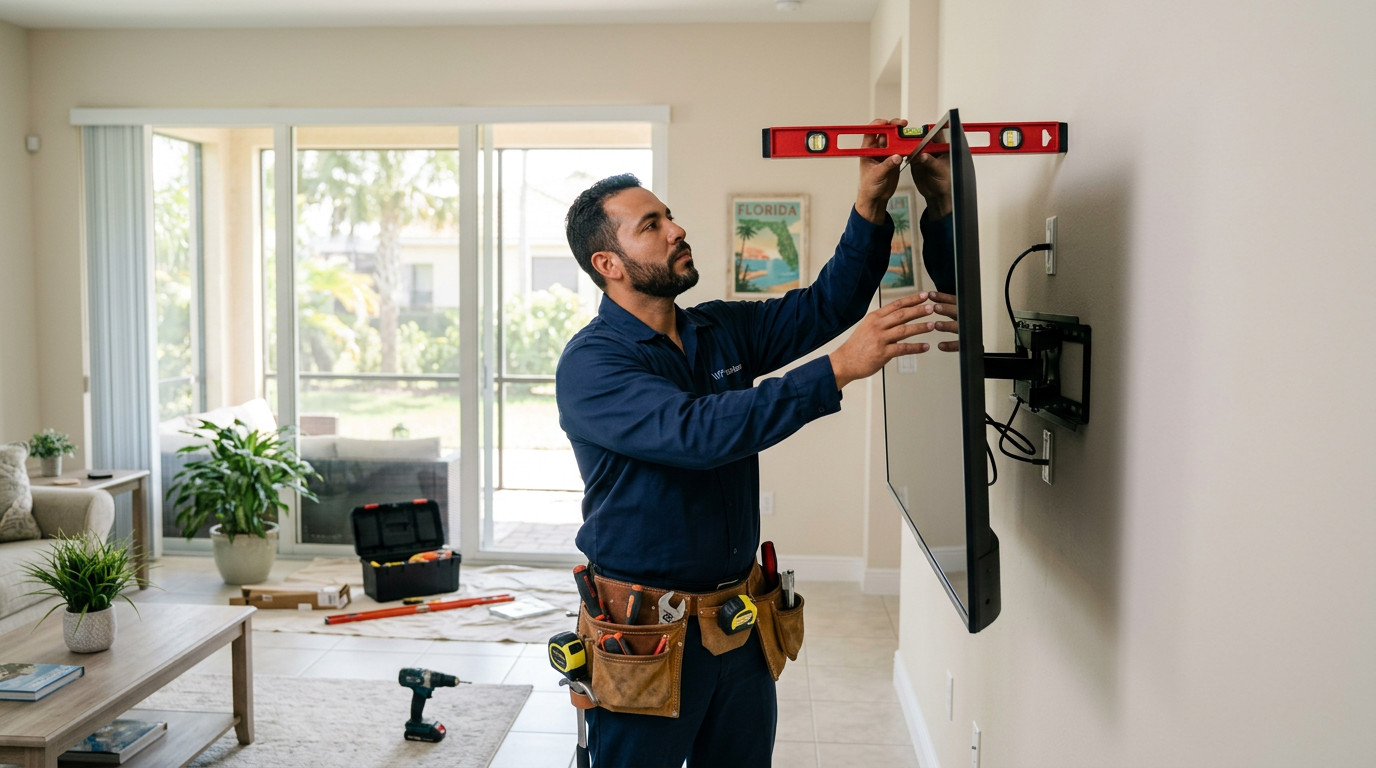
Professional TV Mounting in West Palm Beach costs between $120 and $350 for standard drywall installations, while complex mounting involving concrete masonry units (CMU), high-rise metal studs, or in-wall code-compliant power routing ranges from $250 to $550+. Attempting a quick DIY mount by running flexible power cords directly inside drywall cavities violates Florida Building Code and National Electrical Code (NEC) Section 400.8, posing fire hazards, potential insurance claim denials, and HOA compliance violations. Knowing the exact construction materials behind your plaster, drywall, or stucco dictates whether a screen installation is a simple Saturday project or a structural code liability.
The Anatomy of a West Palm Beach Wall: Why Construction Type Matters
Hanging a 75-inch flat screen in a historic Mediterranean Revival home in El Cid is radically different from mounting that same television in a modern downtown condo overlooking the Intracoastal. West Palm Beach residential architecture spans over a century of building techniques, each introducing specific structural challenges.
Concrete Masonry Units (CMU) and Interior Masonry
In single-family homes across neighborhoods like Flamingo Park, Grandview Heights, and Westgate, exterior walls and structural room dividers are frequently constructed from solid concrete block coated with exterior stucco and interior plaster or furred-out drywall. Furring strips—thin 1x2 wooden strips attached directly to concrete block—provide less than 3/4 inch of clearance behind the drywall.
If you drive standard 2-inch wood lag screws into a furred exterior wall, the screw bit hits solid masonry after penetrating the drywall. Forcing a standard bolt will either snap the fastener, strip the thread cavity out of the thin wooden furring strip, or crack the interior masonry coat. Securing a heavy dynamic mount to CMU requires masonry drill bits, specialized sleeve anchors, or industrial-grade Tapcons anchored directly into the structural concrete core.
Light-Gauge Steel Studs in High-Rise Condos
Residential high-rise towers near CityPlace and the waterfront feature commercial-grade steel stud framing instead of wood studs. Steel studs are thin, hollow channel metals. Standard lag bolts engineered for 2x4 wooden studs will not bite into sheet metal; they simply push through, creating a enlarged hole with zero pull-out strength or load capacity.
Key takeaway: In West Palm Beach high-rises, metal stud walls require heavy-duty toggle anchors engineered for dynamic shear weight; using standard wood lag screws will cause immediate anchor shear and wall collapse.
Historic Plaster and Lath
In historic 1920s bungalows in Spanish Avenue or Northwood Village, walls are made of dense plaster applied over expanded wood or metal lath. Stud finders rarely register accurately through thick plaster. Hammering anchors into historic plaster without pre-drilling causes spiderweb cracking across entire wall segments, requiring extensive Drywall Repair and historical texture matching.
The National Electrical Code (NEC) In-Wall Cable Trap
The most frequent DIY violation in South Florida involves hiding connecting cables. Homeowners frequently cut two small holes in the drywall—one behind the TV and one near the baseboard—and drop the TV’s original factory flexible power cord down through the open wall cavity.
Why In-Wall Power Cord Drops Break Florida Building Code
Under Florida Building Code and National Electrical Code (NEC) Section 400.8 ("Uses Not Permitted"), flexible cords and cables cannot be run through holes in walls, structural ceilings, drop ceilings, or floors. Factory TV cords lack the thick, flame-retardant outer jacketing engineered into non-metallic building wire (such as Romex).
When a standard flexible appliance cord rests inside a wall cavity:
- Thermal build-up: Trapped heat within unventilated drywall cavities degrades the PVC cord jacketing.
- Pest damage: Rodents or insects can easily chew thin power insulation, leading to short circuits inside the wall.
- Frictional wear: Over time, pulling cords through wall cutouts exposes bare copper wire directly against drywall edges or metal stud frames.
If a fire occurs due to an illegal flexible cord drop, home insurance adjusters operating in South Florida may deny the claim due to unpermitted, non-compliant electrical modifications.
Code-Compliant Wiring Alternatives
To legally conceal TV wiring inside your wall in West Palm Beach, you have two safe solutions:
- In-Wall Power Extension Kits (Bridge Kits): These pre-wired snap systems feature code-compliant, fire-rated Romex cable running between an upper recessed socket and a lower inlet plug. The assembly connects to an existing wall outlet using a flexible bridge cable outside the wall.
- Dedicated Recessed Electrical Outlet: A licensed professional installs a standard gang box and recessed duplex receptacle directly behind the mount location. This requires connecting to existing branch circuits, running code-rated cable, and performing proper junction box splices—work often tied into broader Light Fixture Installation and power upgrades.
Dynamic Shear Weight, Tilting Mounts, and Drywall Anchors
A modern 85-inch television weighs between 45 and 90 pounds. While that weight seems manageable, an articulating, full-motion wall arm drastically changes the physics involved. Extending an 80-pound television 24 inches outward from a wall transforms static weight into dynamic leverage.
Dynamic Shear Force Calculation:
  [TV Weight (lbs)] x [Extension Distance from Wall (ft)] = Total Leverage Torque (ft-lbs)
  Example: 85 lb TV extended 2 feet = 170 ft-lbs of rotational force pulling on upper wall anchors.
The Failure of Plastic Expansion Anchors
Plastic drywall anchors or lightweight screw-in hollow-wall anchors are rated strictly for static shear weight hanging flat against the wall (like a picture frame). Under rotational torque from an extended full-motion arm, plastic anchors pull clean out of the gypsum layer, tearing large sections of drywall with them. Over-tightening plastic anchors during DIY assembly also pulverizes the inner gypsum matrix, leaving the anchor with zero holding power.
Mounting to Studs vs. Heavy Duty Toggles
Whenever possible, TV brackets must be centered across solid wall studs using heavy-duty lag bolts that penetrate at least 2 inches into solid wood. Where stud placement prevents exact TV centering, professional installers use spring-loaded steel snap-toggles rated for 200+ pounds of pull-out force per anchor on hollow metal studs or reinforced drywall assemblies.
Key takeaway: Running a standard flexible power cord behind drywall violates NEC Section 400.8 and Florida Building Code, which can void home insurance coverage in the event of an electrical fire.
Condo HOA Rules and Architectural Review Requirements
If you live in a master-planned community like Ibis Golf & Country Club or a downtown West Palm Beach condo tower, mounting a television involves board governance and HOA covenants.
Common Wall Restrictions
In attached townhomes and luxury condominiums, sharing a common party wall (demising wall) means penetrating fire-rated double-layer gypsum assemblies. Disrupting these sound dampening channels or fire barriers with unsealed wall cuts violates HOA bylaws. Condo associations often require:
- Proof of licensed handyman insurance coverage before building entry.
- Work completion within strict weekday hours (typically 9:00 AM to 5:00 PM).
- Sound-damping isolation gaskets placed between metal wall brackets and steel stud framing.
Fire Stop Caulking Requirements
When penetrating fire-rated party walls to run low-voltage HDMI or optical cables, local codes require sealing any conduit or wall cutouts with intumescent fire-stop sealant. This prevents smoke and flame propagation between adjacent condo units during an emergency.
2026 West Palm Beach TV Mounting Cost Breakdown
Understanding local pricing helps homeowners weigh the financial choice between buying proper tools and hardware for a DIY attempt versus hiring an insured professional handyman service.
| Installation Type | Typical Scope of Work | Estimated Cost (WPB Range) |
|---|---|---|
| Standard Drywall Mount (32"–65") | Mounted to wood studs, surface-mounted cable race, hardware included | $120 – $185 |
| Large Screen / Articulating Arm (70"–98") | Multi-stud anchoring, load testing, precision bracket alignment | $185 – $275 |
| CMU / Stucco / Masonry Mounting | Pre-drilling masonry, sleeve anchors/Tapcons, concrete dust isolation | $220 – $340 |
| High-Rise Metal Stud Installation | Steel-toggle anchors, sound-dampening isolators, HOA compliance clearance | $210 – $320 |
| Code-Compliant In-Wall Power Bridge Kit | Dual recessed box assembly, fire-rated inner Romex cabling, low-voltage pass-through | $150 – $250 |
| Drywall Damage Repair (Failed DIY) | Patching pulled anchors, structural backing repair, texture match & paint | $175 – $350 |
The Honest Line: DIY Weekend Job vs. Pro Handyman Job
Deciding whether to tackle your television installation yourself comes down to evaluating wall material, TV weight, and cable routing goals.
Safe for a DIY Weekend Project
- Small to Medium Displays (under 55 inches): Installed on a fixed or basic tilting mount.
- Standard Wood Stud Walls: Clear stud access confirmed using a reliable electronic stud sensor.
- Surface-Mounted Cord Covers: Hiding cords cleanly using paintable PVC surface trunking snapped along the wall exterior (no wall cutting).
- Existing Outlet Nearby: Plugging directly into an existing wall outlet below the television.
When to Call Palm Handyman
- Concrete, Brick, or Plaster Construction: Drilling into exterior block or historic plaster requires specialized hammer drills, dust extraction, and high-shear masonry fasteners.
- High-Rise Metal Stud Framing: Ensuring full load-bearing strength using toggle hardware without stripping structural steel channels.
- In-Wall Cable Concealment: Cutting precise openings and installing code-compliant recessed power bridge assemblies to satisfy NEC standards.
- Over-Fireplace Mounting: Mounting into stone veneer, brick fireplaces, or hollow drywall cavities directly above heating units.
- Integration with Home Maintenance: Combining your installation with general home improvements like Property Maintenance checks, mirror hanging, or home media wall builds.
Prevent costly structural wall failures, electrical code compliance penalties, and crooked viewing angles by choosing experienced local installers familiar with South Florida building assemblies.
Get a free estimate
Protect your home and ensure your high-definition display is securely mounted according to Florida Building Code. Call Palm Handyman today at (561) 299-0890 or book your TV mounting service online at /book for quick, professional service throughout West Palm Beach.
Need a handyman in Palm Beach County?
Get a free written estimate in minutes. Same-day appointments available across PBC.
Related services
Frequently asked questions
Most jobs start at $95 for the first hour with transparent flat-rate pricing on common tasks like TV mounting ($129), ceiling fans ($149), and drywall patches ($95). You'll always get a clear quote before any work begins — no hidden fees.
Yes. We reserve same-day and next-day appointments across Boca Raton, Delray Beach, Boynton Beach, West Palm Beach, Palm Beach Gardens, Jupiter, Lake Worth, and Wellington. Call us before noon for same-day availability.
Absolutely. Palm Handyman is fully licensed in Florida and carries $2M general liability plus workers' comp on every technician. We'll send the COI directly to your HOA or property manager on request.
We cover all of Palm Beach County including Boca Raton, Delray Beach, Boynton Beach, West Palm Beach, Palm Beach Gardens, Jupiter, Lake Worth, Wellington, Palm Beach Island, Manalapan, and Highland Beach.